Local councils are the ultimate place-based organisations. They exist to serve a geographically defined community.
But many of the issues communities care about don’t stop at the boundaries of an LGA and are rarely within the direct control of councl to solve. They involve multiple levels of government, input from diverse stakeholder groups, and co-ordination of networks to achieve change.
This is the case when it comes to big and complex issues like housing affordability, climate change and social cohesion. It is also the case when it comes to the civic health of a local community. This is where mapping your local civic ecosystem can be useful.
It moves beyond a purely place-based view to look at how the different parts of a community connect and work together and, importantly, the “civicness” that binds us together.
Put simply, a council can’t strengthen the civic life of a community if it can’t see the system it is working within. Civic ecosystem mapping offers a way to do just that. A civic ecosystem is the interconnected system of people, communities, organisations, institutions, resources and relationships through which a place understands, discusses and responds to matters of public interest.
The concept is broader than a stakeholder list or a directory of community organisations. It asks us to look at diversity, interdependence (rather than connectedness) and civic purpose. In other words, who is involved, what they contribute, how they depend on or influence one another, and what holds the system together. This is the approach developed by researchers
Iavor Rangelov and Marika Theros through their work on civic ecosystems and social innovation. They define a
civic ecosystem as:
"complex adaptive systems that emerge and self-organize to address specific social problems. They are vehicles for social innovation that leverage complementarity and have distinctive characteristics"
For councils, this provides a useful way of seeing the community not simply as a collection of residents and “stakeholders”, but as a living system of relationships and capabilities. It also provides an opportunity to identify whether there is a shared commitment to norms and values focused on the public interest (ie is the community pulling in the same direction).
Councils are familiar with stakeholder mapping. When developing a new strategy, project or plan, we typically identify residents, businesses, community organisations, state agencies and other groups affected by the issue.
That's often a useful and practical starting point.
Ecosystem mapping takes this to the next level by asking:
“What is the system of people, relationships, capabilities and resources that shapes this issue?”
Rangelov and Theros make an important distinction between networks and ecosystems. Networks focus primarily on connections and communication. Whereas ecosystems focus on diversity and interdependence. That is, the ways different actors enable, constrain or complement one another. This can be harder to identify and typically fluctuates over time - after all an "ecosystem" is a living entity.
The questions become: how does the whole system work? Where are the connections strong? Where are they weak? Who holds trust? Where is capability concentrated? What is missing? And where could a relatively small intervention create a much bigger change?
Local government occupies a distinctive position.
Councils are close to communities, have democratic legitimacy, manage important local infrastructure and services, and often have relationships across government, business and community sectors. In NSW councils also prepare the "Community Strategic Plan" on behalf of the community that sets the long-term vision and outcomes desired by the community. But councils do not control all the resources nor do they make decisions that determine all local outcomes. For example, housing, health, employment, education, transport, climate resilience and social connection all extend beyond council boundaries and responsibilities. Yet they are usually deeply important to the community.
An ecosystem perspective therefore encourages councils to ask:
- Who else is contributing to this outcome?
- What capabilities already exist in the community?
- Who has relationships with people council may not reach?
- Which organisations and people depend upon each other?
- Where does information, funding, trust or influence flow?
- Whose voice is missing? Where are there gaps or duplication?
- What role is council uniquely positioned to play?
This can lead to a different kind of approach which is less about council owning every solution or controlling outcomes. It is more about strengthening the conditions in which local civic capability can flourish.
Research on community ecosystem mapping similarly highlights the value of understanding community demographics, social and cultural settings, community spaces, hard-to-reach groups, champions and communication channels before designing engagement strategies.
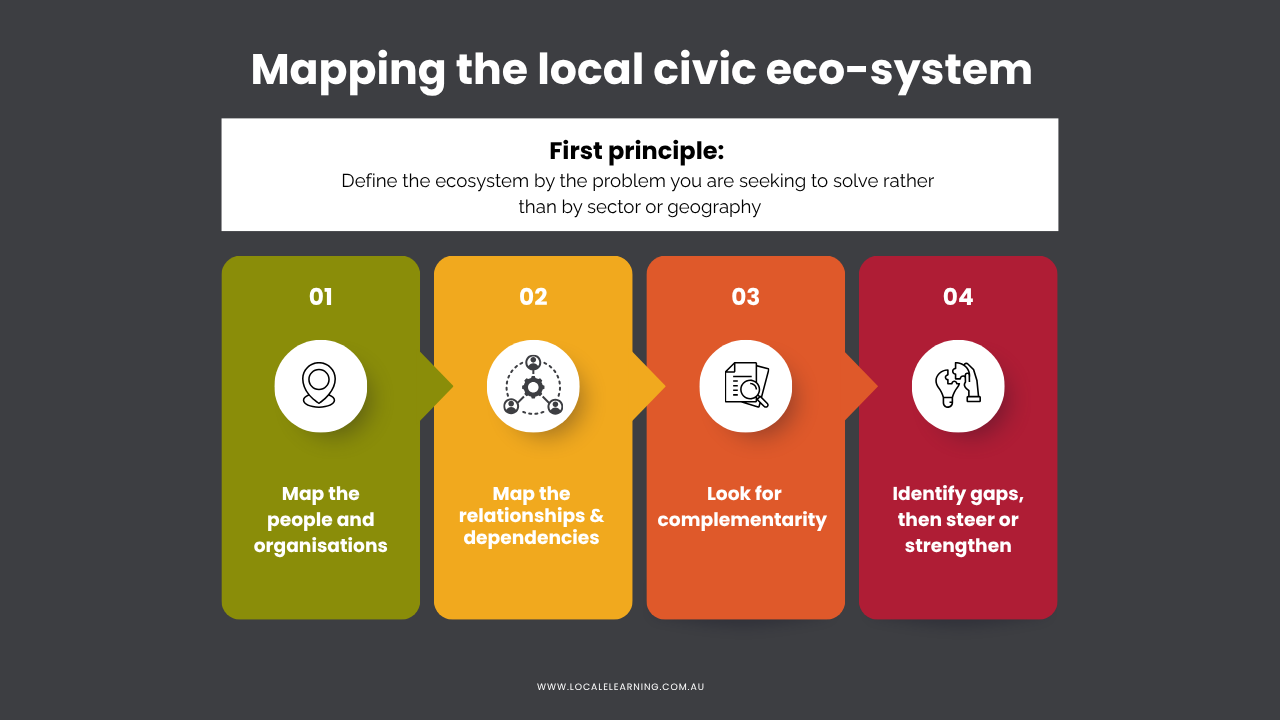
The first principle is simple: s
tart with the issue, not the organisation or even the place. Rangelov and Theros argue that civic ecosystems are problem-specific rather than simply geographically or sectorally bounded. So rather than trying to map “the civic ecosystem of our LGA”, start with questions that are issue specific such as:
- What is the ecosystem that influences young people's participation in local democracy?
- What is the ecosystem supporting older residents digital media literacy?
- What is the ecosystem that creates a sense of civic belonging for vulnerable people in the community?
- What is the ecosystem that enables respectful and constructive discussion of council issues?
Once the question is clear, identify the actors (noting these could be both good and bad!).
After the problem is clearly defined, there are four key steps:
Include the obvious participants such as council, State and Australian Government agencies, schools, TAFE and universities businesses and industry groups, community organisations and charities, sporting and cultural organisations, neighbourhood and residents' groups, libraries and community centres, professional and peak bodies, local media, First Nations organisations and leaders, faith communities, informal community leaders and volunteers and resident-led initiatives. Don't assume that only incorporated organisations count. Some of the most important civic capacity in a community sits in informal relationships.
Then ask what actually flows between these actors.
It might be funding, information, knowledge, trust, influence, volunteers, services, facilities, advocacy, introductions, leadership or data. This is where an ecosystem map becomes much more interesting than a stakeholder register.
You might discover, for example, that council provides funding to a community organisation, while that organisation provides something council cannot easily purchase: trust and access to a particular community. Or that a local business, school and sporting club each have strong relationships with young people but rarely connect with one another.
Those relationships are part of the civic infrastructure of the place.
The goal isn't necessarily to make everyone collaborate with everyone. Instead, look for complementarity. What can different actors contribute that others cannot? A community organisation might contribute lived experience and trust. Council might contribute facilities and convening power. Business might contribute employment opportunities.
The ecosystem becomes stronger when those different capabilities reinforce one another. This is one of the central insights of the civic ecosystem thinking.
Finally, zoom out and look at what isn't there. Who is missing? Which communities aren't represented? Where are relationships dependent on one individual? Where is there capability but no funding? Where is there funding but limited community connection? Where are there “bridges” between groups that aren't otherwise connected?
These gaps can point to opportunities for council, not necessarily to create another program, service or asset but to steer or strengthen the system itself. According to the research, investing in "civicness" (ie our sense of committment to the common good) and diversity is a proven strategy to build the civic health of a community.
There are already examples of ecosystem mapping being used by Australian councils, although much of the Australian practice is described through the language of innovation, economic or community ecosystems rather than the specific term “civic ecosystem”.
For example, Penrith City Council undertook an
Innovation Ecosystem Mapping project with Regional Development Australia Sydney, Western Sydney University and UTS. Council surveyed local startups and mapped organisations, individuals and networks supporting innovation, with the intention of understanding the existing ecosystem and identifying opportunities for council to support its growth.
Sunshine Coast Council provides another example. Its Innovation Ecosystem Mapping Report followed ten months of consultation and research and was used to understand the region's innovation and entrepreneurship ecosystem, establish a basis for benchmarking and identify opportunities for further development.
Whilst these examples are not identical to the civic ecosystem framework developed by Rangelov and Theros, they demonstrate the practical value of understanding the wider system of actors and capabilities available in a place and in response to specific problems relating to our civic health.
An international example comes from
California's Imperial Valley Civic Ecosystem Initiative, where government, local communities, philanthropic organisations and community-based organisations have been brought together to build capacity and improve access to infrastructure and community-development investment. The Imperial Valley is home to one of the world’s largest lithium reserves (a resource that is critical for EV battery production). The initiative explicitly uses the civic ecosystem concept to strengthen connections and capacity rather than relying on government to deliver change alone.
A valuable outcome of the ecosystem mapping approach is the knowledge that it creates. As
Civic Makers describes, this clarifies complexity, reveals gaps & opportunities and builds shared understanding.
The process itself and the conversation it provokes is also valuable.
It can help councillors and council staff see the community differently: not simply as people who receive council services or respond to consultations, but as people and organisations with capabilities, relationships, knowledge and agency. And it can help councils ask a more strategic question:
What could we do differently if we understood ourselves as one important part of the civic ecosystem, rather than the centre of it?
For Australian councils facing increasingly complex challenges and headwinds in local democracy, that may be one of the most useful questions to put on the table.
You catch up on our the earlier articles in our civic series including
> Introduction and why this civics conversation matters
> Part 1: The difference between civic and political leadership
> Part 2: Assessing your civic leadership pipline
> Part 3: Measuring the civic health a local community
Or hit subscribe below to receive our monthly Learning & Leadership brief where we'll be releasing the series especially for local councils and councillors across Australia.
If you want to explore how you can strengthen civic leadership in your community, contact our Founder & Lead Facilitator, Emma Broomfield, on 0421 180 881 or contact@localelearning.com.au for a confidential and obligation free conversation.