There’s a strange irony in Australian democracy. We compulsory-vote harder than almost anyone on earth, yet many Australians feel increasingly disconnected from politics, local government, and civic life.
In 2025 national testing in Australia found only 28% of Year 10 students met civics proficiency standards. This is the lowest result recorded since testing began by the
Australian Curriculum, Assessment and Reporting Authority (Acara) in 2004. It
raises an uncomfortable question:
If local democracy is a team sport, why does more than half the country feel like they accidentally wandered onto the field without the rulebook?
It is clear that we have a civics problem in Australia including at a local government level. The question then becomes: how do we address this?
This series aims to contribute to the conversation by exploring civics at a local government level - the everyday systems, relationships, and decisions that shape local communities. It is our contribution to the civics conversation. Importantly, it focuses on local democracies and the role that local councils play in creating a healthy civic culture at a local level.
Over the series, we’ll look at:
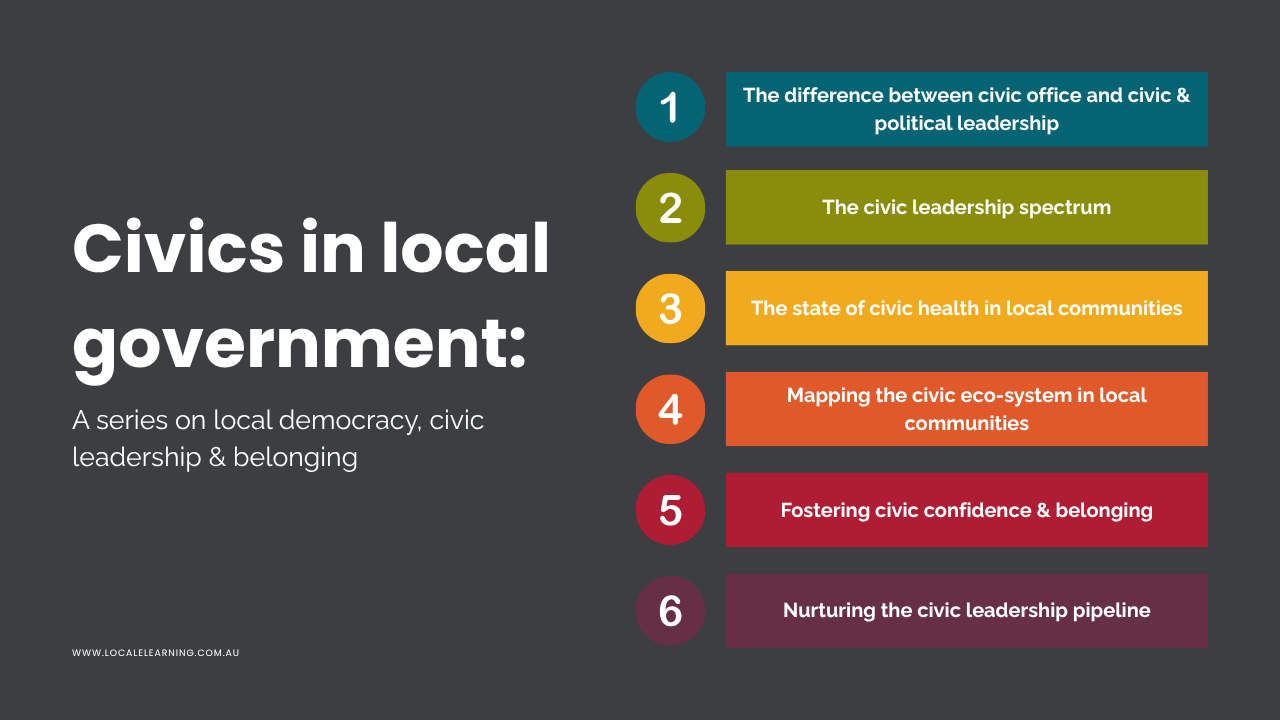
But first, we will go back to the foundations and examine what civics means and where it comes from within the context of local government. Most people hear the word “civics” and immediately think of politics, and
compulsory voting, politicians, Federal Parliament, and confusing ballot papers the size of a picnic tablecloth. However, civics is much broader than this.
The word comes from the Latin civicus, meaning: “relating to citizens.” At its core, civics is the knowledge, skills, values and behaviours that enable people to participate effectively in democratic and community life. It is about both the rights and responsibilities of community members, councillors and democractic institutions such as local councils.
In Australia, civics is traditionally understood as the study of citizenship, government, democracy, rights and responsibilities. It helps people understand how decisions are made, how public institutions function, and how they can contribute to the communities in which they live.
Essentially, it is about understanding what it means to be an active citizen. At a local level, this includes:
- Understanding how your local government operates
- Knowing your rights and responsibilities
- Participating in democratic processes such as voting in the local government election
- Contributing to decisions and issues that impact you and your community
- Working constructively with others for the common good
"Civics is the practice of citizenship: the knowledge, skills and behaviours that enable people to participate in community life, contribute to democratic decision-making, and strengthen the places where they live."
Australia has strong democratic institutions and a long history of being a democratic innovator. Many of our democratic systems and features are envied by others across the world. Despite this, research suggests civic knowledge and participation are weakening .
As noted above, recent studies and inquiries on Australian civics education have repeatedly highlighted declining civic literacy and concern about disengagement from democratic participation. As noted earlier, recent national civics testing showed:
- only 43% of Year 6 students met proficiency standards,
- only 28% of Year 10 students did.
This points to a deep and concerning gap in our civic capability that does not get corrected once kids leave school. It also suggests that younger people are not g
iven meaningful ways to understand or participate in civic life. And this needs to change.
It also well documented that trust in government, including local government, is declining. The latest Edelman Trust Barometer found that we are living in the age of insularity, where people do not want to speak to people who are different to them. This should concern us all, as it means people not only don't understand the democractic systems that they are part of, but they are also not willing to understand why others see things differently to themselves. This means civic ignorance is increasingly being compounded by civic alienation.
And finally, there is attraction and retention problem when it comes to our elected leaders in local government. Anecdotally, we hear that people that would have previously considered running for their local council are deterred from doing so because of the increasing incivility. People who do run are often unprepared (or under prepared) for the role. And too many first term councillors are exiting the sector due to the the demands and challenges.
Add to the mix the increasing incivility and mis/disinformation in online spaces, it is clear that there needs to be a renewed focus on civics at a local level. This is the foundation that builds decent humans who recognise our shared humanity and the responsibilities that we owe each other to live a good life. And we need to focus on it at a local level.
There is a lot of focus on improving our civic capability at a Federal level with many working to improve how civic education and knowledge is embedded into our education systems. And this should be continued. But most people experience civics locally and well after school has finished.
People encounter the local civic eco-system at different points of their life and in different places (online and in the real world):
- parents notice whether the local park gets upgraded once they have young kids
- newcomers to an area pick up on the civic health of the local community via the local Facebook page
- new residents to the country learn about citizenship when they are welcomed in a citizen ceremony
- older people notice when the library hosts events to support healthy ageing
- vulnerable people see how volunteers organise to support them in flood recovery efforts
- young people learn when they have to vote in their local government election for the first time
Civics is deeply local, yet there has been limited focus on how to improve civics at a local level and specifically within local government. It is often framed in the context of improving community engagement or reaching 'hard to reach' audiences. But what if we flipped the script? What if civics was embedded into the everyday culture, decision-making, and ways of working within local government? And councils led the conversation in this space?
Join us over the coming months as we explore how civics works at a local level and within local democracy.
Hit subscribe below to receive our monthly Learning & Leadership brief where we'll be releasing our series especially for local councils and councillors across Australia.
If you want to explore how you can strengthen civic leadership in your community, contact our Founder & Lead Facilitator, Emma Broomfield, on 0421 180 881 or contact@localelearning.com.au for a confidential and obligation free conversation.