At its heart, civic leadership is about serving the community and being a steward for the common good. It is about putting the interests of the community above your own and acting with integrity and good intent to create positive change.
When we think about what this looks like in practice, it is easy to picture a Mayor at a council meeting or an elected councillor sitting in the Chamber. But civic leadership in a local community is much broader than formal civic office.
Across Australian communities, civic leadership comes in all shapes and sizes and can be seen in many different facets of our society and local communities. Some leaders have the authority to make decisions on behalf of the community. Others influence decisions through their knowledge, relationships, advocacy, lived experience or ability to bring people together. Still others lead through everyday actions that strengthen community life. This reflects the fact that civic leadership is not a single role. It is a spectrum of influence, responsibility and action that exists within local communities. And as the Menzies Leadership Foundation says:
"leadership is a shared responsibility rather than the preserve of formal authority alone"
- Menzies Leadership Foundation
This broader understanding of civic leadership has important implications for local government. We're living in age of rapid change and disruption, where we need to solve complex societal challenges. These challenges are impacting local communities but are often out of the direct control of local councils. To solve these problems, we need to tap into all forms of civic leadership capability within communities. However, with changes in our media landscape from print to digital and in how people get involved in their community, it can be harder to see the leaders. And councils have a tendency to face inwards when they measure civic leadership.
Local councils can also no longer assume that their future elected leaders will simply emerge when a vacancy occurs or an election approaches. There is increasing evidence mounting about the challenges of elected office that are deterring people from running or staying in office. The
Better Politics Foundation study in the mental health of Australian politicians found that 66% of respondents said the role had adversely affected their mental wellbeing. A recent survey from
Women for Election shows that this is also a gendered issue with women facing serious risks of harm from online abuse that is deterring them from running for, or staying in, office.
If councils want to build a pipeline for civic leadership for the future, they need to understand the leadership capability that already exists within their community, identify where future leaders may emerge, and consider what pathways, experiences and support can help everyday citizens to become more involved.
Our civic leadership pipeline is a tool to support councils to assess the civic leadership capability in their communities. It presents seven forms of civic leadership that are common in local communities and explains how these roles move from formal authority to informal influence and rely upon different types of power. It does not necessarily mean that one form of leadership is more valuable than another. Rather, it demonstrates that different forms of leadership that can produce different kinds of civic impact, and together leadership becomes a shared capability within a community.
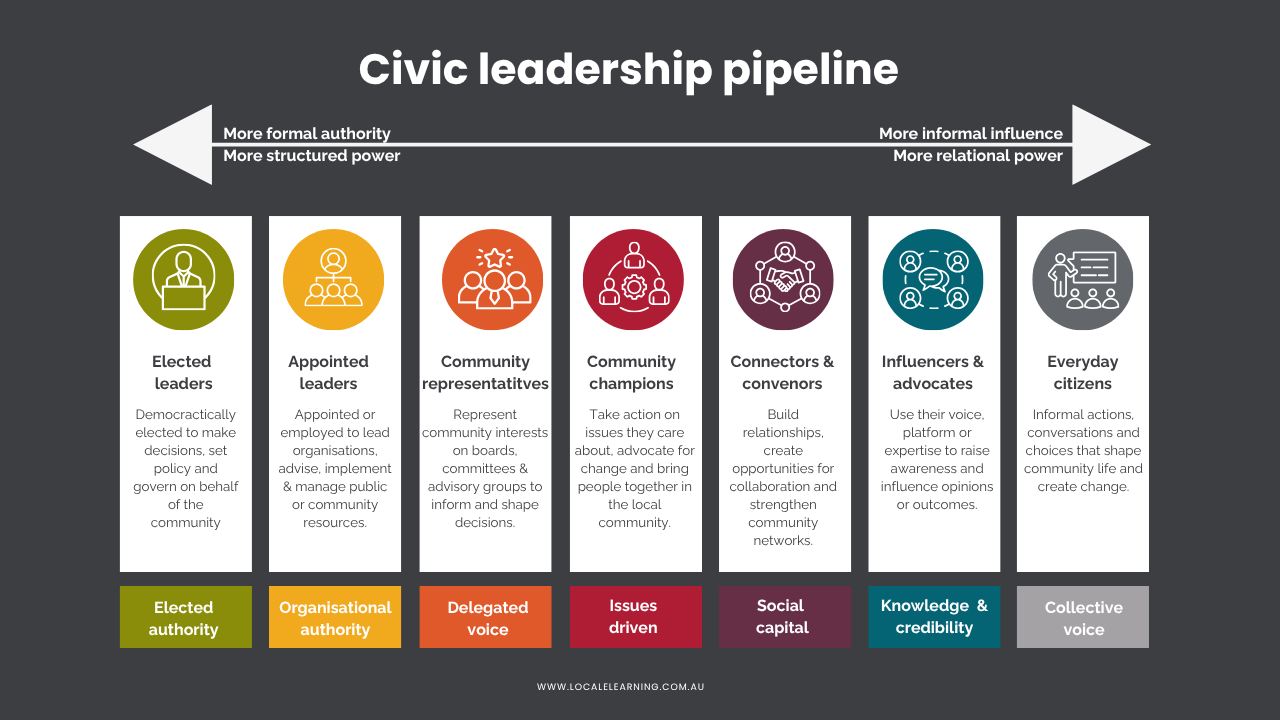
At the formal end of the spectrum are elected leaders. At a local level, this is the Mayors and councillors who have a democratic mandate to make decisions, establish policy and govern on behalf of their communities. Their leadership is grounded in elected authority.
In Australia, there are approximately 5,500 local councillors across 537 local government areas. When compared with Australia’s population of nearly 28 million people, this means only a very small number of individuals ever end up holding these formal positions of civic leadership. This authority comes with significant responsibilities. Elected leaders must balance competing interests, make decisions in the public interest and statutory responsibilities, and remain accountable to the community at election time.
The next level is appointed leaders. This includes General Managers, CEOs, council staff and others appointed to lead organisations or manage public resources. Their influence comes primarily from organisational authority. Unlike elected leaders, they are not directly elected by the community. These roles are responsible for implementing council decisions and managing the delivery of services, budgets, and organisational strategy.
Their influence is significant because they translate policy into action and advise elected leaders on feasibility and implementation. While not elected, they hold substantial administrative and operational authority in a local democracy and are often visible and active in their communities. They will also be judged by the community for their leadership.
Between formal leadership positions and grassroots community leadership are community representatives. These might include people serving on council advisory committees, boards, reference groups or other formal governance structures. Their power is described as having delegated voice.
They have a responsibility to bring community perspectives into decision-making processes and will often be appointed after an expression of interest process. This requires more than simply expressing their own personal opinions. This form of civic leadership is particularly important because it can create a bridge between council and community experience.
Community champions often emerge around a particular local issue. They see something that matters to their community and decide to act. Their leadership is driven by issues and purpose, rather than necessarily by formal authority. A community champion might advocate for better local facilities, support vulnerable residents, campaign for environmental improvements, promote community safety or bring attention to an issue that has previously been overlooked. Their influence comes from their willingness to care, organise, advocate and persist.
Some of the most important civic leaders are not necessarily the people appointed to the committee or heading the residents group. These are the connectors and convenors who build relationships and networks. They know who needs to talk to whom, create opportunities for collaboration and bring people together around shared interests. Their power comes from social capital and leadership in this form is often exercised behind the scenes. Their leadership is fundamentally relational. Civic leaders in this space demonstrate that sometimes the most valuable civic action is not telling people what to do, but creating the conditions in which people can work together.
Influencers and advocates use their voice, expertise, experience or public credibility to raise awareness and shape opinions. Their influence may come from professional knowledge, lived experience, community standing, communication skills or a platform that enables them to reach others (such as the local Facebook group). This is because knowledge and credibility are a form of civic power. An advocate might draw attention to an issue that has not received sufficient public attention. An expert might help a community understand complex evidence. Someone with lived experience might change the way policymakers understand a problem.
At the broadest end of the spectrum are everyday citizens. People exercise civic leadership through informal conversations with neighbours, volunteering, participating in local activities, joining community groups, sharing information and attending community meetings. Individually, these actions may appear small. Collectively, they can be transformative. The power here is collective voice: the capacity of citizens to shape community life through participation and action.
Councils regularly assess their finances, workforce, risks, assets and organisational capability. Councils also often include "civic leadership" as one of the core pillars in their long-term strategic planning, but this is usually internally facing. It is worth asking:
- When did your council last assess the civic leadership capability of the community itself?
- Do you have known and established pathways for people to move into more formal positions of civic leadership?
- Are you developing the leaders needed in the future?
- Does your civic leadership pipeline reflect the community?
- What happens if you need new leaders to step forward tomorrow?
A civic leadership audit provides a high-level picture of who holds formal positions of influence versus those who act and influence behind the scenes. Importantly, councils have an opportunity to deliberately identify and develop pathways for people to step into different forms of leadership and if desired, more formal positions of civic leadership.
This could include emerging leaders programs that focus on the qualities and skills needed for civic leadership, mentoring opportunities for people who are curious to learn more about how local government works, community events where people learn about what council does and how to be involved in their local community, and opportunities for residents to develop confidence and civic capability in places that they already go.
Perhaps the most important question is simply:
If we looked five years ahead, would we be confident that our council and community are developing the leaders we need for the future?
If the answer is "we don't know" that may be an opportunity. Taking time to understand the civic leadership capability of the local community can help councils build stronger relationships, identify emerging leaders, broaden participation and become less dependent on the same established voices. And importantly, ensure that come election time, there is a diverse group of people willing to consider more formal civic leadership roles.
We encourage you to read the introduction to this series and part one which explores the meaning civic office and unpacks the difference between political and civic leadership.
Then hit subscribe below to receive our monthly Learning & Leadership brief where we'll be releasing our civic series each month: curated especially for local councils and councillors across Australia.
If you want to explore how you can strengthen civic leadership in your community, contact our Founder & Lead Facilitator, Emma Broomfield, on 0421 180 881 or contact@localelearning.com.au for a confidential and obligation free conversation.