At a recent conference, a long-serving local government practitioner remarked that councillors had not always been viewed as politicians. The comment caught our attention because it challenged an assumption at the heart of our local democracies: that councillors are, by definition, politicians. But is that necessarily true?
The answer is more nuanced than it might first appear. This article explores the nature of civic office, the role councillors hold within local government, and whether that roles fits within concepts of civic and political leadership. In doing so, it considers whether the distinction between politician and civic leader is merely semantic or whether it offers a deeper understanding of the councillor's place in Australia's system of local democracy.
To understand this issue, it is helpful to begin with the legal framework that gives councillors their powers and authority. In Australia, the concept of civic office is closely associated with local government and democratic representation. While the terminology varies between jurisdictions, where the term is used it refers to elected offices within local government, such as mayor and councillor.
The concept has its origins in British municipal governance, which was adopted by the Australian colonies during the nineteenth century. As municipalities were established to manage local roads, public works and community services, elected councillors became the representatives of their local communities, while mayors assumed civic leadership and ceremonial responsibilities. These offices formed the foundation of local democratic governance and continue to underpin the role of councils today.
Significantly, Members of State and Commonwealth Parliaments do not hold civic office. Rather, they hold constitutional or parliamentary office. The concept of civic office is unique to local government and reflects the distinctive role councillors play in representing and governing local communities.
In New South Wales, local councillors hold a position of "civic office" under the Local Government Act 1993 (similar legislation exists in other jurisdictions in Australia). Councillors are officially sworn into the role and take an oath or affirmation of office after the election. The role carries legal and ethical responsibilities, decision-making authority as part of the governing body, and accountability to the community under the local government legislation. The offices of mayor, deputy mayor and councillor together form the civic leadership of council.
Councillors are elected to "civic office" through a democratic process to:
- Represent the interests of the community
- Participate in decision-making as part of the governing body
- Oversee the strategic direction and long-term planning of the local government area, and
Ensure accountability, transparency and good governance
An important legal distinction is that holding civic office is not employment. Councillors are elected office holders who exercise statutory powers and owe their duties to the public. Council employees, by contrast, are appointed under employment arrangements and perform administrative and operational functions under the direction of the chief executive
Below is a snapshot of the key elements of civic office:
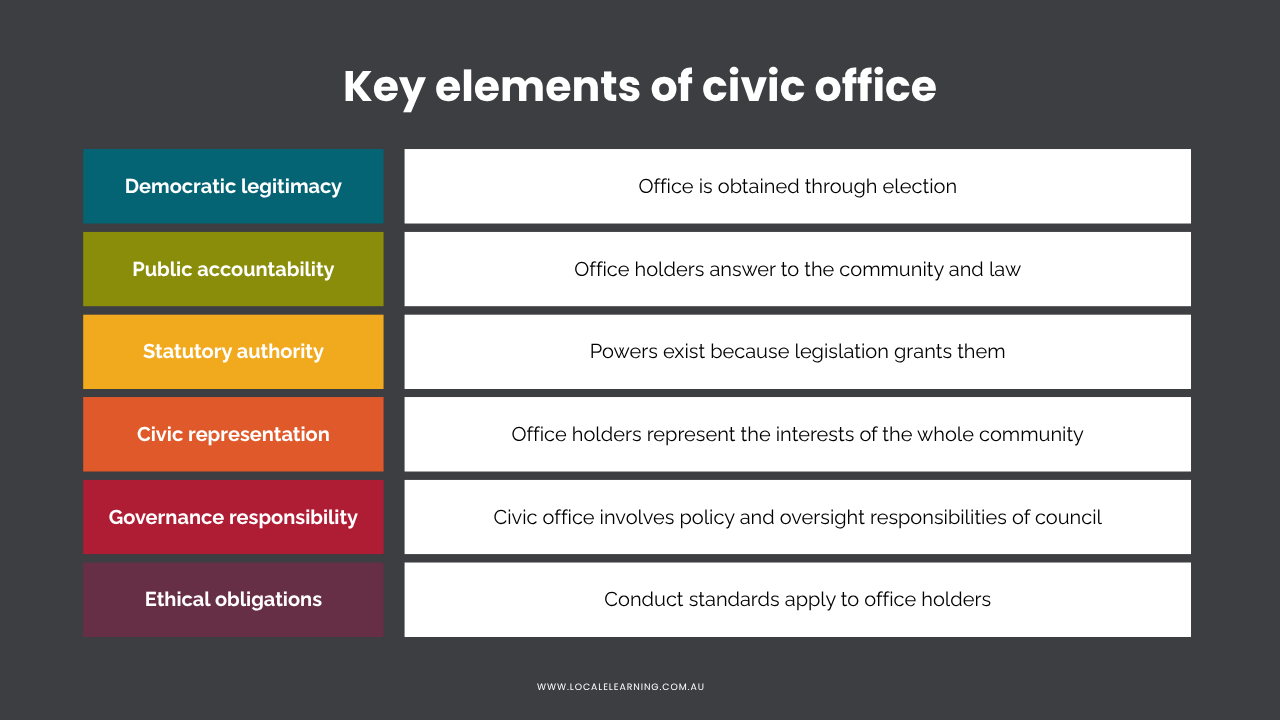
Holding civic office also carries an expectation of civic leadership. As members of the governing body (the elected council), councillors are expected to provide leadership, represent their communities, and help shape the future of their local government area. In that sense, councillors are civic leaders because leadership is an integral part of the office they hold.
Civic leadership, however, is not confined to elected office. It is much broader than local government and does not depend on being elected. At its core, civic leadership is the ability to influence, mobilise and strengthen communities through participation, collaboration and advocacy. Civic leaders can be found throughout every community, including:
- Community organisers, advocates and activists
- First Nations elders
- Youth leaders like school captains
- Nonprofit board or committee members
- Local business leaders
- Residents leading community initiatives and projects
-
The administrator of the local Facebook page
- Representatives on council committees
- Volunteers with local sporting groups & cultural organisation
- Staff within local government and other public sector organisations
Strong local democracy depends on both. Councillors provide civic leadership through the authority of elected office, while many others exercise civic leadership through their commitment, influence and service. Together, they strengthen community participation and help create connected and well-governed places.
Returning to the question posed at the outset, where does politics fit within the role of an elected leader in local government? Is the role of a councillor simply one of civic leadership, or is it also political?
In our view, holding civic office is inherently political. Councillors make decisions about how their communities are governed, how public resources are allocated, and how competing interests are balanced. They debate, negotiate and vote on matters that affect the lives of their communities. In doing so, they exercise public power, and the exercise of public power is, by its nature, political. Indeed, one of the greatest adjustments for people moving from informal community leadership into elected office is recognising that civic leadership and politics are inseparable in a democratic system.
At the same time, describing councillors as politicians requires some nuance. In the ordinary sense of the word, councillors are politicians because they hold elected public office and participate in democratic decision-making. However, local government differs from state and federal politics. Most councillors serve part-time, many have careers outside local government, and in many councils political parties play little or no role. Their politics is often less about party affiliation and more about representing community interests, resolving competing priorities and making decisions in the public interest.
Civic leadership and political leadership are not mutually exclusive in local government. Both are essential, but each emphasises a different aspect of the councillor's role.
Describing a councillor as a politician highlights that they are elected through a democratic process, make decisions involving competing interests, exercise public power and are accountable to voters. For some, however, the term also carries associations with partisan politics and political self-interest. It can feel icky.
Describing a councillor as a civic leader emphasises their responsibility to represent the whole community, provide stewardship, act in the public interest and strengthen civic life. It is also a description that resonates with many councillors, who see themselves first and foremost as community leaders.
Ultimately, the label matters less than the office itself. Councillors hold civic office, exercise civic leadership and perform a political role in the service of local democracy. It is through these three dimensions that local communities govern themselves, making councillors among the most important custodians of democratic participation at the local level.
Join us over the coming months as we explore how civics works at a local level and within local democracy. Missed the introduction to the series?
Read it here. Or continue onto
part two where we explore the civic leadership spectrum within local communities.
Hit subscribe below to receive our monthly Learning & Leadership brief where we'll be releasing the series especially for local councils, councillors and communities across Australia.
If you want to explore how you can strengthen civic leadership in your community, contact our Founder & Lead Facilitator, Emma Broomfield, on 0421 180 881 or contact@localelearning.com.au for a confidential and obligation free conversation.