Local government has become increasingly sophisticated at measuring all kinds of things including the level of wellbeing in the community. Many councils now routinely track liveability, housing metrics, safety, social connection and residents’ satisfaction with local services, communication and engagement.
But there is a related question that receives far less attention:
How healthy is the civic life of the community itself?
That is a different question and an increasingly important one. Civic health asks whether people have the relationships, trust, agency, belonging and capacity to participate in local community life and in local democracy. It poses questions such as:
- Do people trust one another? And do they trust local institutions including your local council?
- Are they are informed about local issues and decisions that impact them?
- Do they feel they have a voice in local decisions and can meaningfully influence them?
- Do they participate in community life?
- Do they know how to access information and be involved in local decisions?
- Are the people who hold formal positions of power reflective of the diversity of the community?
- Do people understand how to vote in a local government election? Do they know the candidates?
The civic capacity of community is the foundation of society - the invisible glue that binds us together. It becomes critical and more visible when a community faces disruption: a housing crisis, natural disaster, contentious development proposal, social division or rapid demographic change.
The state of our civic health at a national level has been examined by the
Menzies Leadership Foundation back in 2024 when it released the report "The Civic Health of Australia: A National Portrait in 30 Charts." The report paints a concerning picture of Australia’s civic health, revealing declines across three crucial dimensions:
This refers to how people feel, learn about, and take actions related to political, societal or local issues. Measures include receiving information about civics and citizenship, trust in government and government integrity, accountability and transparency. The report found that there is a deep distrust of politicians and political parties, with politicians seen to have a weak commitment to the common good. There has also been a sharp decline in our satisfaction with democracy in recent years. At a local government level, it is seen as incompetent and lacking in integrity. Moreover, people don't believe they can influence politics and they tend to lean towards engaging via simple methods such as petitions.
This includes how people interact and talk with others about important community and societal issues, and how much they trust and help their neighbours. Measures include trusting people in the community, connecting with people of different backgrounds, helping neighbours, and discussing important issues. The report found that we generally trust each other in Australia and whilst social cohesion is under pressure, it is also resilient, with moderate stocks of social capital. However, people think we're more divided than in the past and that we can't have constructive debates about things we disagree on.
This includes how much people are giving their time or money to serve the community or contribute to causes they care about. Measures include volunteering for an initiative or organisation, charitable giving, political giving, and participating in community, civic, religious and sport organisations. The report found that over the longer-term both volunteering and participation in groups have declined, and again people prefer simple forms of civic participation.
The
ABS General Social Survey provides another useful measure of our national civic health by measuring trust, volunteering, social connection, participation and wellbeing. Its 2025 results are sobering:
- only 50% of Australians agreed that most people can be trusted, compared with 55% in 2019
- organisational volunteering was 23%, down from 30% in 2019
- life satisfaction was 7.1/10, compared with 7.5 in 2019
At a local level, there are some insightful data sets available to explore.
The
Scanlon Foundation Research Institute provides perhaps the strongest existing Australian platform for measuring this territory. Its Social Cohesion Compass provides LGA-level data across the Scanlon Index and a Democracy Index, including domains such as belonging, participation, social inclusion, institutional confidence and political participation. It also maps engagement and participation levels against income and education at an LGA level, painting clear picture of where each LGA sits compared to others.
Another useful tool for understanding measures of civic health at the LGA level is the
Early Insights for More Resilient Communities created in partnership by University of Canberra, SGS Economics & Planning and Southern NSW Innovation. This dashboard can be searched at an LGA level to show information about the categories of resilience resources available to the community such as financial resources, social connections and services.
In New South Wales, the
Office of Local Government Your Council website provides accessible data on several data points that are relevant to civic health. This includes the number of councillors per population, the diversity of councillors by gender, First Nations and CALD, as well as stats on the number of libraries, library circulation per capita, population mix and SIFA ranking.
Taking an international angle,
The Civic Information Index, provides inspiration for how civic health could be measured at a local level with 27 data sets tracking things like library visits, voter participation, food and housing insecurity, the existence of local news outlets and journalists, among others. It organises civic health into five domains - news and information, civic participation, equity and justice, health and opportunity, and environmental resilience - providing a wholistic lens into the civic health of a community.
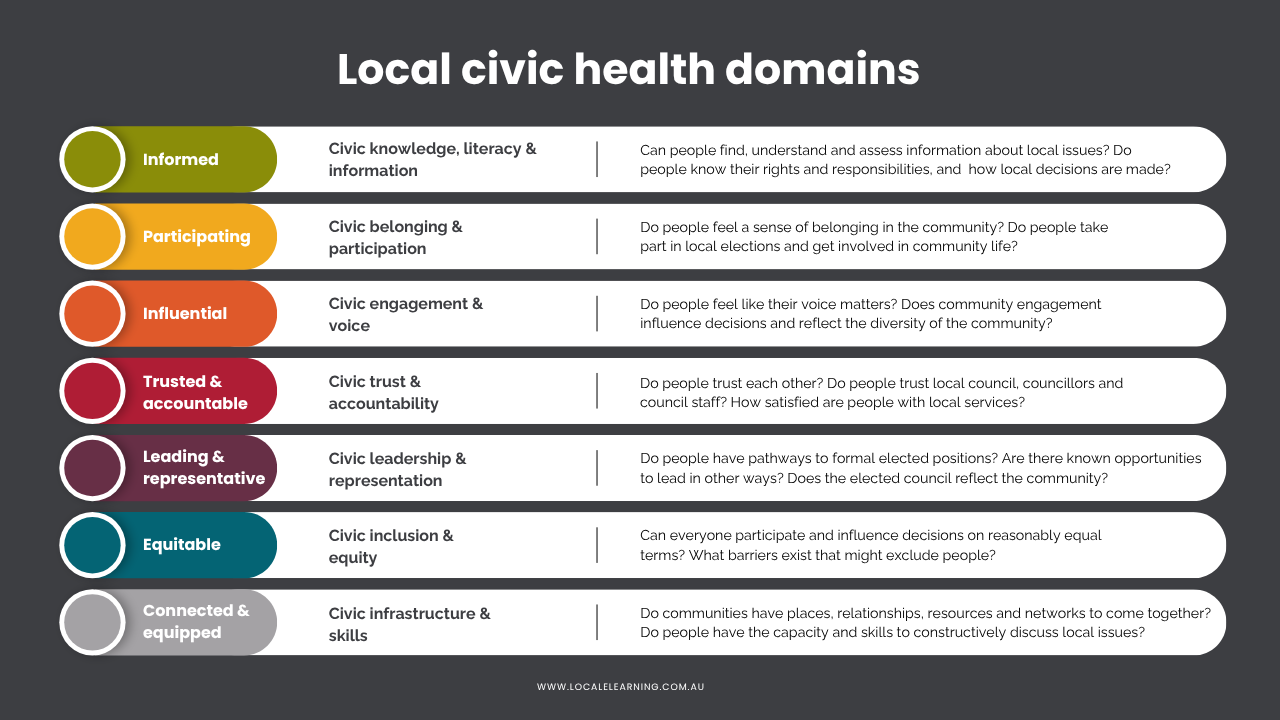
Whilst there is no specific index currently available for local councils to assess the civic health of their community, councils can begin to better understand the baseline by assessing and documenting their civic health across the following seven domains:
-
Civic knowledge, literacy & information: Can people find, understand and assess information about local issues? Do people know their rights and responsibilities, and how local decisions are made?
-
Civic belonging & participation: Do people feel a sense of belonging in the community? Do people take part in local elections and get involved in community life?
-
Civic engagement & voice: Do people feel like their voice matters? Does community engagement influence decisions and reflect the diversity of the community?
-
Civic trust & accountability: Do people trust each other? Do people trust local council, councillors and council staff? How satisfied are people with local services?
-
Civic leadership & representation: Do people have pathways to formal elected positions? Are there known opportunities to lead in other ways? Does the elected council reflect the community?
-
Civic inclusion & equity: Can everyone participate and influence decisions on reasonably equal terms? What barriers exist that might exclude people?
-
Civic infrastructure & skills: Do communities have places, relationships, resources and networks to come together? Do people have the capacity and skills to constructively discuss local issues?
In addition to better understanding the civic health of their local community, there are at least three practical areas where councils can work to strengthen civic capability at a local level (with or without a clear baseline and targets for change):
1. Invest in the physical and social infrastructure that supports the conditions for civic health - there is much within council's direct control and influence including essential public spaces like libraries.
2. Shift from consultation to participation opportunities to build a sense of civic belonging and agency - local councils generally do a great job on consulting communities about specific projects, but there is more work to be done in building people's capacity to engage and it needs to happen way before the project starts.
3. Actively develop pathways and opportunities for civic leadership across the whole spectrum (hint: read more about our civic leadership spectrum here) and across the election cycle - this might be the most controversial idea because could be seen as a political. We firmly believe councils have a role here, whether as a leader, partner or supporter in this space.